 76e9289fcf
* 🐛 Fix stroke to path dropping caps and markers

Caps and markers (round ends, arrows, square/diamond/circle markers) are
painted separately by `handle_stroke_caps` after the stroke itself, so
`stroke_to_path` — which only outlines the shape path — dropped them.
Converting a stroke to a path lost every end decoration except the
Round/Round and Square/Square pairs Skia draws natively, and even those
were missing because the outline paint kept the default butt cap.

Cap geometry now lives in `shapes/stroke_paths.rs` as plain path
builders, shared by the canvas renderer and by `stroke_to_path`, which
unions the caps into the outline for open paths and honors
`to_skia_linecap`. The SVG export no longer overlays the caps a second
time on top of the expanded outline, which would double the alpha of
translucent strokes; the clip silhouette for image strokes gets them
from the outline too.

Co-authored-by: Shreyash Agare <agareshreyash26@gmail.com>
Penpot WASM render
This is the canvas-based WebAssembly render engine for Penpot.
Rust & Emscripten
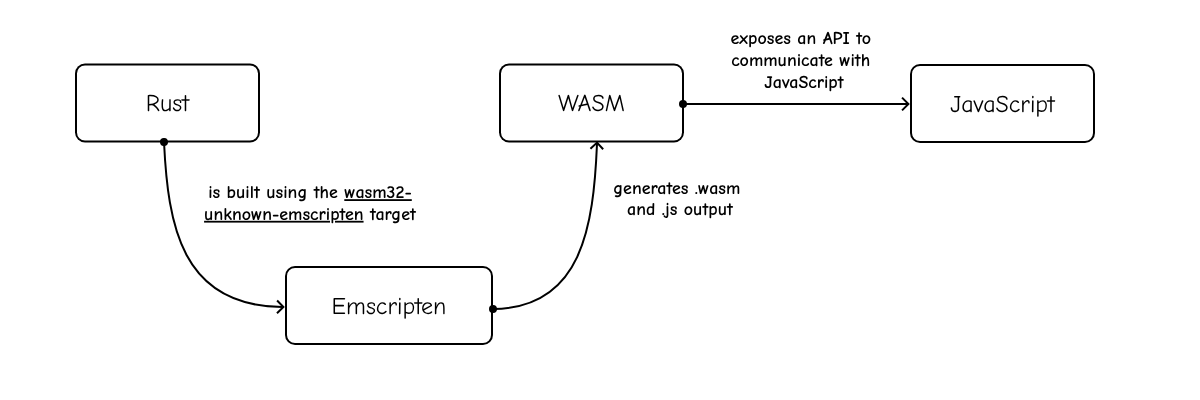
This project is a Rust crate that targets Emscripten (wasm32-unknown-emscripten).
We use wasm32-unknown-emscripten compilation target:
- It compiles Rust code into WASM
- It generates the JavaScript code (“glue”) to load and run the WASM code
Skia
We use Skia, an Open Source 2D graphics library. In particular, the render engine uses Skia via custom binaries of the rust-skia crate.
How to build
With the Penpot Development Environment running, create a new tab in the tmux.
cd penpot/render-wasm
./build
You can also use ./watch to run the build on every change.
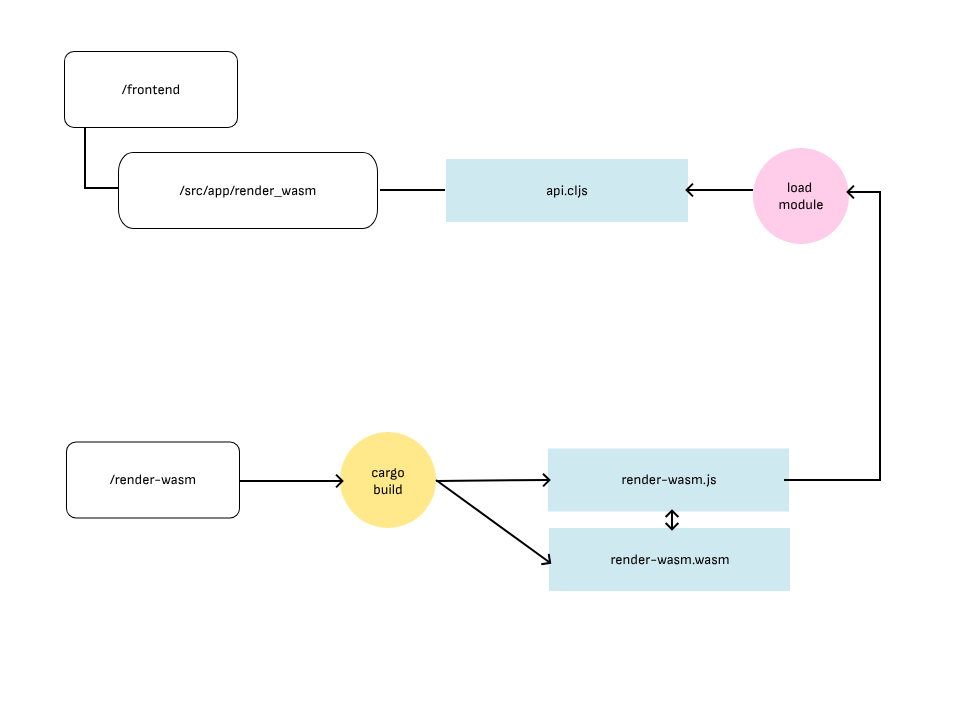
The build script will compile the project and copy the .js and .wasm files to their correct location within the frontend app.
Render targets
The same Rust source produces two artifacts, which differ only in compiler options:
| Target | Tuned for | Cargo profile | Consumed by |
|---|---|---|---|
frontend |
speed | release (-O3) |
frontend/resources/public/js |
export |
size | size (-Oz) |
exporter/resources/wasm |
./build            # both targets, frontend first
./build frontend   # workspace / viewer renderer
./build export     # headless exporter renderer
./watch still follows a single target (frontend unless you pass one),
since watching both would rebuild twice on every keystroke.
Each target keeps its own CARGO_TARGET_DIR (target/<target>), so switching
between them does not invalidate the other's cache. Set BUILD_MODE=release
(or NODE_ENV=production) for an optimized build; the default is debug.
Each target writes its own generated shared.js (the enum discriminants the
CLJS side compiles against) next to the code that imports it — respectively
frontend/src/app/render_wasm/api/shared.js and
exporter/src/app/wasm/shared.js. Neither build writes to the other's paths.
Edit your local frontend/resources/public/js/config.js to add the following flags:
enable-feature-render-wasmto enable this render engine.enable-render-wasm-dpr(optional), to enable using the device pixel ratio.
How to test
We currently have two types of tests:
- Unit tests
cd penpot/render-wasm
./test